The main part of prevention can be narrowed down into three risk factors: Nicotine, Obesity, and Genetic Risks. The problems are from overconsumption or sometimes even just one consumption, for nicotine at least. A big difference in habits that can be started early is just doing less of each thing that is bad for you. Below I detail each bad habit and discuss why it really damages your body, giving physical reasoning behind it rather than just cause and effect to build a full understanding of the problem. Your body is a lot more fragile than you believe it to be, meaning that we have to take care of our bodies if we want to live a long and heart healthy life.
Another huge part of being healthy is wanting to change and creating better habits. The only person who you have to convince to change is yourself. It will take a ton of discipline and mental fortitude, but it will be amazing in the end that you can do anything that you set your mind to. Don’t think about it as a smoking gun to your head but instead think about improving yourself slowly and taking a small step towards a longer life. The most happiness you can get won’t come from fast food, but longer time spent with your family and friends in a healthy life.
Nicotine
Nicotine is the worst thing you could ever do to your body, let
alone your heart. If you were to only get one thing from this
website, it would be Don’t Use Nicotine. It is so
addictive that even one puff can cause cravings. Nicotine is shown
to be as, if not more addictive than cocaine and heroin, the
most addictive drugs in the world. Every tobacco product contains
nicotine, meaning any form of smoking, chewing, vaping, and so
on cause rapid addiction. The beginning of this path stems often
from being a teenager, when struggling and looking for a social
place in the world, but the effects of this addiction are lifelong.
70% of people who start want to quit, but they wait until
Heart Disease, lung disease, and any other chronic illness afflicts them
before quitting tobacco, which may be too late. If you are a
teenager, young adult, or even a younger kid, never take up
smoking or any tobacco use. I get it can be hard, some social
situations may arise, but see the
Mentality Aspect
for advice on these situations.
Why is Nicotine harmful? It is one of the most addictive substances
in the world, but what actual harm is there? All tobacco products
have nicotine in them and many tobacco products, like vapes and
carts, are evolving faster than science can keep up with in terms
of health defects. Cigarette smoke contains around 9000 chemicals,
69 of which are known
Carcinogens. Nicotine spreads into the body and increases heart rate,
elevates blood pressure, and increases heart muscle flexibility, all
unnatural states for the body to be in, causing damage to the
Endothelium
tissue of vascular smooth cells, rapidly increasing the chances and
speed of
Atherosclerosis
in the body. This happens because the endothelium
is damaged and cut, meaning
that blood flow forms
atheromas , which can cause blood clots inside the blood vessels.
This puts you at risk of developing
Coronary Artery Disease,
Strokes, and
Acute Myocardial Ischemias.
Obesity
What if I told you that 40 percent of the US and a billion
people in the world are incredibly unhealthy, so unhealthy
that it puts them at risk of diseases and
Cardiac Arrest,
on a daily basis? Obesity is a state of a BMI of around 30,
meaning that your body has too much fat and doesn’t know
what to do with it. Our bodies are not adapted to the modern
day and cannot process fast food or fructose carbs in a
healthy way, so we store them as fat.
Obesity is bad because it leads to a high risk of
Diabetes, Atherosclerosis, Arrhythmias, and Cardiomyopathy.
Diabetes cuts off your blood flow across your body and causes loss of eyes,
feet, and fingers in severe cases. The massive weight of the fat damages muscles
and bones, causing simple movements to become tiring and exhausting.
Being obese cuts your life span by around 10-20 years and affects almost
half of America. Every part of life becomes more inconvenient and your body
becomes damaged for each year you’re in this state; these are just the down
sides from a heart health perspective.
Obesity takes away from all your other functions, compressing your organs
to function less optimally. It prevents you from playing a sport or even
just going on a walk without getting out of breath. It is the result of
simple overeating of bad foods and saturated fats. Dieting may seem hard
but you never have to follow a strict diet if you just generally eat healthy.
It’s ok to have a few fries or one cookie every now and then, though,
the excess amount is what causes the damage and diseases to affect your body.
For diet ideas, try the
Mediterranean Diet, but simply avoid saturated fats and processed sugars and carbs. Eat mainly vegetables and white or fish meats with plenty of fruits and whole grain foods daily. This will make a huge change to your life and literally take the weight off your shoulders.
Genetic Risks
Genetic risk factors are tiny differences in your DNA
that can increase the chance of you getting a certain
disease later in life. Think of your DNA as a giant
instruction manual for your body; if there is a "typo"
or a change in those instructions, some parts of your
body might not work perfectly. Some of these risk factors
come from one major gene change, such as the ones that
normally act like "brakes" to stop cancer from growing,
while other risks come from thousands of small changes
that add up together. Knowing your genetic risk is like
having a weather report for your health because it helps
you prepare before a problem even starts.
If you are pre-disposed to developing a certain type of cancer,
figuring this out early could help treat it before it becomes a
life-threatening problem. You can tell the difference in DNA and
see the risk factors from previous members of your family and their
medical history. If your great grandpa randomly had a heart attack
at 80, I wouldn’t worry about that being a risk factor, but if each
lady on your mom’s side has developed breast cancer at the age of
40-50 years, then I would talk to your doctor about that and figure
out a plan of prevention. This is the only risk factor that can’t
really be handled on your own, but that makes it easier to cover.
Go see your doctors about medical history and ask about risk factors
and what you can do to find yours.
Mentality
Addiction is almost seen as the opposite of a habit,
but it is just a very bad habit that is quite hard
to break. Many of the
risk factors
for heart disease
result in the lack of a good habit or the gain of
a bad one. The most important, first step is:
you need to want to make a change. Many people
are told by their doctors, “do this step” or
“eat this diet for a bit,” but it always falls through.
The importance of wanting to make a change cannot be
understated. Nobody can make you want to live a
better and longer life, it is as simple as that.
If there isn’t a will, there isn’t a way, but
that’s the beautiful thing about humans. We can
create a will out of thin air, only using
discipline every day. The best day to start is
today. Give up waiting for the right time
or waiting for some event to happen, we live one
life and the best thing you can do is pick up a
new habit today that serves you tomorrow. Once you
have that will, that want for change and a healthier
life, it is as simple as maintaining that discipline each day.
Discipline
Discipline is sometimes hard to keep up, your drive
fades occasionally, but it is important to keep going
each time it does. Each day you get home from school
or work and don’t want to stick to your diet or routine
of exercise, that is the most important day to keep
with it. There will be obstacles, like peer pressure,
laziness, and temptation but even if you falter on
a diet for one day, get back up the next day and keep
going. The most important discipline to maintain is
never smoking in your life. It is horrible for your
health and can be avoided by just never doing it.
Even if a group of friends are all doing it, and that
goes for any habit on this list, find the power to say
no; find the power to be different and stick to your
diet or workout every day.
Situations of extreme peer pressure may arise even with
the most comfortable groups, but it is important to have
a plan to avoid giving in. It is hard to find the strength
in the moment to say no but if you have prepared for it
beforehand it gets significantly easier. Planning goes
great for every obstacle of discipline, in fact I recommend
taking time to think about potential moments of slip-up
before you begin your plan of change so you are prepared
mentally for the obstacles on the way and do not have to
worry about them stacking up before you address them.
Habit Creation
Habit Creation is easy when you really boil it down to its roots. It takes a plan and time to do each part of the plan. Start with a list of things you want to change or add to your schedule. It could be eating less desserts or going for a run in the morning, it doesn’t have to be all at once, just keep adding in parts as you get consistent with the new ones you add in. Once you have the plan, find time in the day to go out and do it. The first three days may feel hard, running in the morning instead of sleeping, saying no to a big steak at a restaurant with friends, but once you get the habit implanted into your brain, it becomes easier each day.
Your brain is wired to give
dopamine,
when something good for your survival occurs, but nowadays there are so many bad things that give artificial dopamine that undermine the reward system of the actual positive improvements and habits you make. Practice cutting off bad habits that give dopamine like scrolling short form content or eating fast food every day and focus on the only dopamine your brain receives being from good habits like eating healthy and exercise. Whenever you pick up a new habit or take a break, do it sparingly. Exercise 8 hours a day becomes as harmful as sitting on a couch if done to those extremes. It is important to
One of the biggest pitfalls of a good habit is, “earning the right to go back or take a break for a bit.” The way our brain works is through phases and states, meaning that once you’re in a productive or positive state, it is easy to keep going as long as you do not exit the phase. Temptations will arise and exiting means losing all of your progress, imagine slipping up on a diet one year in, that was 365 days under your belt that are lost through one moment of indulgence. It is ok to indulge a little bit after sticking to a good habit, but do not indulge back into the bad habit, instead find something new you enjoy to reward yourself with like going out with friends to eat at a new restaurant and ordering a healthy dish instead of ordering fast food on your cheat day. The enjoyment comes from being with your friends and trying a new place rather than eating poorly for just one day.
Prevention steps
The key part of prevention is creating a plan. Once you have a plan in your head, following the habit each day just becomes a matter of resisting urges until it becomes a habit. Starting a new habit, trying a new exercise schedule, or even eating better is all scary and hard to do in your current situation, because you are not setting up the right mental and physical area for change. Once you have that down, there are a few more things to integrate as good habits down below:
Food and Diet
Food and Diet is one of the most important steps of
prevention. Even if you’re in the prime fitness of
your life, your cardiovascular health could still
be lacking. Avoiding the wrong foods and eating a
good amount of the right ones can ensure a long
life and some tasty meals. Regardless of the food,
the most important part of dieting is Don’t Eat in Excess.
Even if you eat only a somewhat healthy diet and
have fast food every now and then, it's not the
fries that kill you, it’s the amount you eat and
how much you eat them. A simple change to make is
to just watch how much you eat and try to cut out
fast food and sweets consumption to only one time
per week. This simple change can make a huge
difference in the span of your life.
A great diet has so many other benefits than just surviving a long
life in a great condition, (if that wasn’t already good enough.)
It feels filling, but never bloated, it gives you great energy and
corrects all internal functions, like dopamine cycles and the circadian rhythm. It puts your body back in the state of eating that it was meant for, not the world we live in today. We evolved in a time of simple foods and starvation, so our bodies became accustomed to that. Now that we have fatty foods and sweets, (which were programmed to give the most satisfaction as they fill us up the longest,) at our fingertips constantly, we need to use our brains to regulate not our stomachs. Our brains chase dopamine naturally and seek foods that give the most, which is why eating unhealthy can feel like an addiction, it is an addiction. The way to beat it is to take the power away from impulse and hunger and plan out what you’re gonna eat each day to ensure you feel full and can avoid impulse eating.
Dieting can be simple if you break it down to two steps: replacement and commitment. Take each thing you like eating and find a healthy alternative. We live in such an advanced world that even though sweets and fats are designed to be so addictive, science has created tons of healthy alternatives. These can sometimes be risky too with alternate sweeteners and many ingredients, so to keep it simple: buy whole foods and natural ingredients then cook them yourself. This ensures that no unhealthy preservatives are in your food and bring your body back to eating natural food like it is made for. Organic foods are often more filling as well, meaning you don’t have to eat as many calorie dense meals to fill your stomach for the day. The second step is commitment. Discipline is important in a diet and can be the difference between success and failure. It is going to be hard at first, but it will get so much easier the longer you commit. Have a day planned out in the week to cook all your meals so you have it prepared for those long nights when you may be tempted to order out or buy only healthy foods so no unhealthy options sit around the house and tempt you. Planning is key to changing bad habits, so make sure you create a reasonable plan to an exact time and stick with it each week.
Dieting isn’t all white rice and chicken, unseasoned in a bowl.
There are plenty of good recipes that are heart healthy that taste
amazing. For a good guideline of foods to use to cook meals,
let us talk about the Mediterranean Diet. The Mediterranean Diet,
the MedDiet, is a widespread diet known for reducing the risk of a
CVD, but how effective is it? It contains a lack of sugars,
red meats, dairy, and saturated fats but encourages eating fish
at least three times a week; eat nuts, seafood, and legumes at
least three times a week; eat olive oil and plenty of vegetables
and fruits daily, along with plenty of whole grain carbs.
This is a strict diet that actually relies heavily on daily
physical exercise and weight management, portioning the food
to what is needed of course. This diet has semi-consistent
results that aren't 100% confirmed. The diet of course increases
health and cardiac health in general, but the exact percentages
are not known at this date. The studies are quite hard to track
exact changes but there are consistent positive results for the
diet. One of the big causes of the deadliest disease in America,
Coronary Artery Disease, is from damage of the arteries around
the heart from plaque build-up, atherosclerosis. Atherosclerosis
can occur anywhere in the body from high cholesterol and high
blood pressure, but it is most deadly in the heart. These two
risk factors can be caused by being obese, having an unhealthy
diet, and excess eating. Diabetes can also cause issues with
blood flow in the heart as it damages nerves, blood vessels,
and heart muscles from high blood sugar in the blood.
The Mediterranean diet’s goal is to rid the body of refined
carbohydrates and bad fats, essentially unclogging the body
by changing what would clog it in the first place, being one
of the best preventative measures of heart disease out there.
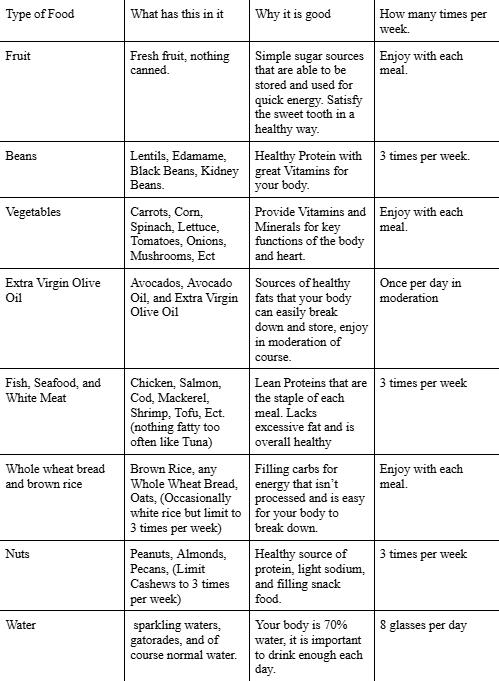
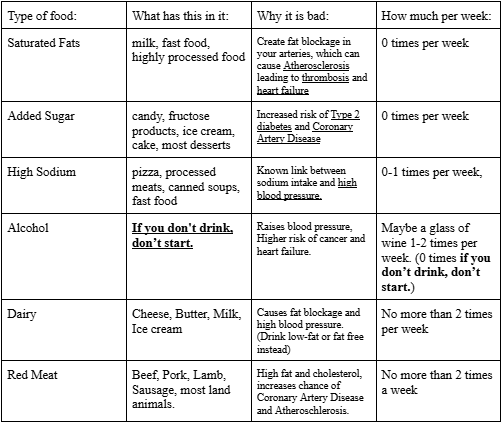
For more information, see the graph below to see some good
foods to eat and bad foods to avoid.
Foods to focus on eating and why they benefit you
(click to see full size)
Foods to avoid and why they are bad for you
(click to see full size)
Exercise
It can be hard to start exercising out of nowhere, but that is the beauty in it. Just because you can’t bench 400 pounds or run 26 miles in a day doesn’t mean you shouldn’t push yourself. A simple 30 minute walk or jog a day is a great starting point and even if you stay at just this, it is very healthy for your heart. The worst thing you can do is sit around and do nothing; this actively damages your body. The critical point is that we work in a “use it or lose it” state of being. If we do not exercise and stretch daily, we slowly lose our flexibility and muscle mass. Your cardiovascular health is the exact same, if you do not do some form of cardio, (running, walking, swimming, biking, or any workout machine), for at least thirty minutes four times a week, your body deteriorates. Exercise isn’t even all bad, it releases dopamine, causes fitness and can elongate lifespan by up to 20 years, allowing you to enjoy being in your 70s, being able to explore the world instead of just sitting in a nursing home. It is the difference between playing a sport in your 40s or being stuck to a desk all day, becoming out of breath going up the stairs. Just do 30 minutes a day if you can, I promise it will save your quality of life for a long, long time.
See your Doctor about Genetic Risks
Genetics are the inherited patterns of genes you
get from your parents, they determine how you look,
how your body functions, even the color of your eyes,
and everything in between. These genetics can also
carry mutations, which are genetic irregularities that
are passed down from parent to child, or even from grandparents
or great-grandparents. These mutations can create a huge risk
of certain diseases, including heart diseases. “A genetic
variation (mutation) in a single gene can affect the likelihood
of developing heart disease” (PMC). Knowing Genetic Risk
Factors that run in your family can help treat many diseases
before they even start. These risks can be as far back in
your family as medical records go, so it is important to give
your doctor this information so they have the ability to
correctly
diagnose
and treat a possible condition that may
afflict you in the future.